
IMAGO RELATIONSHIP THERAPY · TUCSON, AZ
IMAGO Therapy: a new way to hear each other
Mastering communication where it counts
Feeling unheard does not have to be the end of the conversation. Imago Relationship Therapy is a structured approach to couples counseling that helps partners slow down recurring disagreements, understand the experiences behind their reactions, and practice more respectful conversations. At Caritas Center for Healing in Tucson, Arizona, Karen Olson, MA, LPC, brings this relationship-centered method to couples seeking clarity, compassion, and practical communication tools.
Whether arguments have become predictable or you simply want to strengthen an already caring partnership, Imago offers a way to become curious about each other again. The goal is not to declare a winner in every disagreement. It is to make room for two perspectives while building a relationship in which both people can be heard.

Karen Olson, MA, LPC · Certified Imago Therapist & Workshop Presenter · Caritas Center for Healing
What is Imago Relationship Therapy?
Short answer: Imago Relationship Therapy is a form of couples counseling developed by Harville Hendrix and Helen LaKelly Hunt. It uses a structured conversation process, often called the Imago Dialogue, to help partners listen accurately, recognize one another’s perspectives, and respond with empathy. Its relationship model also explores how earlier experiences may shape expectations, sensitivities, and recurring conflict in adult partnerships.
The Latin word imago means “image.” Within this approach, the term refers to an internal picture of love and relationships that may develop through early experiences with caregivers and significant others. This is a way of understanding patterns, not a claim that every relationship problem comes from childhood. People are also shaped by current stress, health, finances, culture, responsibilities, and daily circumstances.
Imago sessions encourage couples to move from reacting automatically to responding deliberately. When one person shares, the other practices listening before correcting, defending, or giving advice. Each partner then has a turn. For some couples, that slower pace creates space to notice needs that were previously hidden under blame or withdrawal.
How the Imago Dialogue works
At the heart of Imago is a three-part listening practice. The steps are straightforward, but practicing them when emotions run high can take time. A counselor may guide the pace and help both partners make room for a full, respectful exchange. The process emphasizes understanding first; it does not require either person to agree with everything the other says.
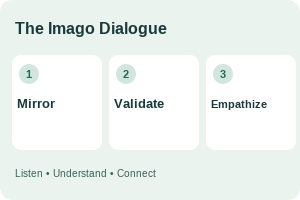
1. Mirroring: The listener reflects the speaker’s message in their own words and checks for accuracy. Instead of planning a rebuttal, they might say, “What I’m hearing is that you felt alone when I changed our plans without checking with you. Did I understand?” The speaker can clarify until they feel represented fairly.
2. Validation: The listener acknowledges that the speaker’s reaction makes sense from the speaker’s point of view. Validation is not surrendering one’s own opinion. It might sound like, “I can see why the change felt dismissive when you had been looking forward to the evening.” Two different experiences can both deserve consideration.
3. Empathy: The listener considers the feelings underneath the words, then asks whether the guess is accurate. For example: “I imagine you may have felt disappointed and unimportant. Is that close?” The speaker confirms or corrects the impression, rather than having feelings assigned to them.
After one person has been heard, partners change roles. Over time, this ritual can make difficult topics more manageable by replacing assumptions with questions. It is a skill couples can continue practicing between appointments, adjusting the length and depth of the conversation to their comfort.
Helpful practice: Start with a low-stakes topic before using these steps for a painful disagreement. If either partner becomes overwhelmed, pause and return when both people can participate freely.
Who may benefit from Imago couples counseling?
When conversations keep circling
Couples often ask about Imago because communication feels stuck. One person may pursue a conversation while the other shuts down. A small disappointment may become a major argument. The same disagreement about time, money, family, intimacy, or household responsibilities may return again and again without either partner feeling understood.
Imago may be a useful approach when both partners want to participate in learning new communication habits. It can also appeal to couples who are doing reasonably well but would like to deepen connection before a major life transition, such as marriage, parenthood, retirement, relocation, or a change in caregiving roles.
What partners may work toward
Common goals include: understanding repetitive arguments; expressing needs without accusation; listening without interrupting; recognizing emotional triggers; rebuilding everyday appreciation; discussing differences more gently; and developing rituals for continued conversation outside the counseling room.
The fit matters. If there is intimidation, coercive control, threats, or fear of retaliation, ordinary joint dialogue may be unsafe. In those circumstances, contact a qualified professional who can assess safety and recommend individual support or specialized services. No communication technique should be used to pressure someone to remain in an unsafe relationship.
What can you expect from an Imago session?
Beginning couples counseling can feel vulnerable, especially if previous conversations have left both of you discouraged. The first step is to contact the practitioner and ask whether the method, appointment format, and current availability fit your circumstances. You can share broad goals without trying to explain your entire relationship history in an initial inquiry.
In an Imago-informed appointment, the practitioner may ask what each person hopes will change, how arguments typically unfold, and what helps each partner feel respected and secure. Rather than looking for one person to blame, the conversation considers the interaction between you: what happens before tension rises, how each person protects themselves, and which responses keep the cycle going.
A therapist may introduce the dialogue in small stages. You might first practice saying one sentence about your experience, then listening as your partner reflects it. Later, you may explore difficult patterns or how past experiences influence present expectations. The pace should reflect your needs, consent, and capacity to participate. If a subject feels too intense, it is reasonable to ask about slowing down or changing focus.
Between sessions, couples may choose to practice brief check-ins, appreciative statements, or structured listening at home. Progress does not always look like never disagreeing. It can look like noticing an argument sooner, returning to a conversation after a pause, or understanding why a particular topic feels so important to your partner. Your practitioner can discuss how these practices fit into a larger treatment plan, and whether another kind of support would be more appropriate.
Imago Therapy in Tucson with Karen Olson
At Caritas Center for Healing, couples can learn about Imago Relationship Therapy through the work of Karen Olson, MA, LPC. Karen is the founder of Caritas, a licensed professional counselor, a certified Imago therapist, and an Imago workshop presenter. Her practitioner profile describes advanced training with Maya Kollman and a focus on helping couples communicate with greater understanding and compassion.
Caritas was founded in 2007 and is located in the historic Armory Park neighborhood near downtown Tucson. The center brings together independent practitioners and offers counseling alongside other wellness and educational services. Its emphasis on compassionate, whole-person support aligns with the patient, relational approach of Imago work.
If you live in Tucson or nearby communities, it can be valuable to choose a counselor whose training, philosophy, and communication style feel like a good match. Ask about session format, fees, availability, and what to expect in an initial appointment. The center’s practitioner information and contact page are the best places to verify current details.
Visit: Caritas Center for Healing, 330 E. 16th Street, Tucson, AZ 85701. Contact Karen: (520) 940-0486. General center phone: (520) 624-2743. When reaching out, mention Imago couples counseling so the team can direct your inquiry appropriately.
Couples workshops: Getting the Love You Want
Some couples prefer a concentrated experience rather than learning the ideas only in shorter sessions. Caritas offers Getting the Love You Want couples workshops led by Karen Olson. These workshops draw on the Imago model and typically combine teaching, guided exercises, and opportunities for partners to practice structured conversation together.
A workshop can provide time to explore relationship patterns away from the interruptions of ordinary life. Participants may reflect on how conflict develops, experiment with new ways of listening, and identify practical habits to take home. Group activities and privacy arrangements vary by workshop, so review the current event description before enrolling. Workshops are educational experiences and should not be assumed to be equivalent to any particular number of therapy sessions.
Caritas posts upcoming dates and registration details on its workshops page. Because schedules, pricing, and availability change, check the current listing or contact the center rather than relying on older event announcements.
Imago Relationship Therapy: frequently asked questions
Is Imago Therapy only for couples in crisis?
No. Some partners seek support after years of repeated conflict, while others want to strengthen an already positive relationship. The approach emphasizes communication, curiosity, and mutual understanding. A practitioner can help determine whether Imago is a good match for the particular concerns you bring.
How is Imago different from ordinary couples counseling?
Imago places special emphasis on a recognizable dialogue structure: mirroring, validation, and empathy. It also explores how earlier relationship experiences may contribute to present expectations. Other couples therapies may use different theories and interventions, so the best fit depends on your goals, preferences, and clinical needs.
Do we have to agree with each other during the dialogue?
No. Validating another person means recognizing how their experience makes sense to them, not declaring that their interpretation is the only correct one. Both partners are invited to speak. Learning to tolerate two perspectives without escalating can be one of the most useful skills in the process.
What if my partner is unsure about counseling?
It is common for two people to feel differently about asking for help. You might begin by discussing what each of you hopes to gain, what worries you, and what type of first contact feels comfortable. Participation should be voluntary. If your partner declines, you can still seek appropriate individual guidance about your own needs and choices.
How many sessions of Imago Therapy will we need?
There is no universal number. Your goals, relationship history, current stressors, safety, and the kinds of changes you want to make all matter. Ask your counselor how progress will be reviewed and how you will decide together whether to continue, adjust the plan, or explore a different service.
Does research prove Imago works for every couple?
No. Research on Imago includes some encouraging findings for communication and satisfaction, but the evidence base is smaller and less conclusive than for several other couples-therapy approaches. Results vary across couples. A 2017 randomized trial found improvements in satisfaction but did not establish clinically significant change for the group as a whole. It is best viewed as an option to discuss, not a guaranteed result.
Can we learn Imago skills through a workshop?
Caritas offers Getting the Love You Want workshops led by Karen Olson, a certified Imago therapist and workshop presenter. These events give participants a concentrated opportunity to learn and practice relationship skills. Visit the current workshops page for dates, registration details, and whether the format suits your needs.
Where can we ask about Imago counseling in Tucson?
Caritas Center for Healing is located at 330 E. 16th Street in Tucson, Arizona. To ask about Imago counseling with Karen Olson, use the Caritas contact page or call Karen at (520) 940-0486. The general center number is (520) 624-2743. Confirm availability and costs directly.
This information is educational and does not replace an individual assessment by a licensed professional.
A conversation can be a fresh starting point
More compassionate conversations begin with a willingness to listen differently. If you are curious whether Imago Relationship Therapy could support your partnership, contact Caritas Center for Healing to discuss your goals, ask about Karen Olson’s current availability, or explore an upcoming couples workshop.
Caritas Center for Healing serves Tucson and the surrounding area from 330 E. 16th Street. If you are unsure which service to request, the center can direct you to the appropriate practitioner or information page.
Further reading: Harville Hendrix on the Imago Dialogue · 2017 randomized trial of Imago Relationship Therapy · Caritas practitioner credentials. Content is intended for education, not a promise of individual outcomes.